Yom Kippur: Meaning, Date, Restrictions and the Significance of “Gmar Chatima Tova”


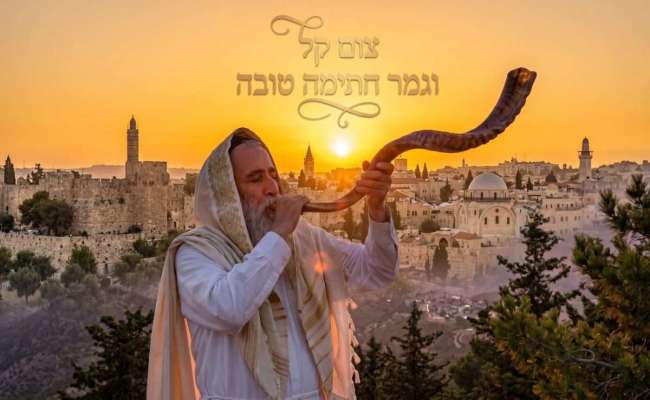
Every year, millions of people worldwide completely abandon their daily routines for 24 hours to observe the traditions of the most important and revered day in the Jewish calendar. Ahead of this event, we have compiled answers to the most frequently asked questions to help explain its core significance.
This article explores the true meaning of the holiday, how its date is determined, the strict 24-hour restrictions observed, and the exact meaning of the traditional greeting “Gmar Chatima Tova.”
What is Yom Kippur and what does the holiday mean?
Yom Kippur—which translates from Hebrew as the Day of Atonement or Judgment Day—is the holiest, most significant, and most solemn day in Judaism. It is observed on the 10th day of the Jewish month of Tishrei, typically falling in September or October, and marks the end of the Ten Days of Repentance that begin on the Jewish New Year, Rosh Hashanah.
The primary focus of Yom Kippur is repentance, the atonement of sins, and reconciliation. According to Jewish tradition, it is on this day that God hands down the final judgment for every individual for the year ahead and seals the Book of Life.
On this day, individuals are expected to leave behind all worldly concerns and focus entirely on their spiritual well-being. Before the holiday begins, custom dictates that people must seek forgiveness from anyone they may have intentionally or unintentionally wronged over the past year. Judaism teaches that God only forgives sins committed against Him, such as violating divine commandments. Sins against others, however, are forgiven by God only after the offender has reconciled with the person they wronged.
Why is Yom Kippur Celebrated on Different Dates?
In reality, Yom Kippur is always observed on the exact same date: the 10th of Tishrei. The illusion that the date constantly changes arises simply because we are accustomed to the Gregorian calendar, whereas Jewish holidays are tied to their own lunisolar calendar.
The standard Gregorian calendar is based strictly on the solar cycle, consisting of 365 or 366 days. The Jewish calendar, however, measures months by the phases of the moon, making a regular lunar year about 354 days long. Because of this 11-day difference, Jewish dates shift backward each year relative to the calendar we typically use.
If this drift were not compensated for, the autumn holiday of Yom Kippur would gradually move into summer, and eventually into spring. To keep the holidays in their historical seasons, the Jewish calendar employs a leap-year system. Seven times within a 19-year cycle, an entire 13th month is added to the year. During these leap years, the dates of Jewish holidays are pushed back relative to the Gregorian calendar.
It is precisely because of these constant shifts and the periodic addition of a full month that the 10th of Tishrei falls on a different Gregorian date each time.
As a result, Yom Kippur always falls between mid-September and early October.
What is Forbidden on the Day of Atonement
For approximately 25 hours, from sunset until the stars appear the following day, worshippers observe strict restrictions. These are divided into the denial of physical pleasures to “afflict the soul” and a complete ban on creative work.
The main rule of this day is a strict fast, which entails a total abstention from food and any liquids, including water. Additionally, bathing for pleasure, taking a shower, brushing teeth, and rinsing the mouth are prohibited. Only minimal washing of the fingers is permitted upon waking or after using the restroom. Applying creams, lotions, ointments, perfumes, or oils to the body is also forbidden. Another important rule concerns clothing: leather shoes are not worn on Yom Kippur, replaced instead by footwear made of rubber, plastic, or fabric. Marital intimacy and any forms of physical affection are similarly banned on this day.
Beyond physical restrictions, absolutely all the rules of Shabbat apply on Yom Kippur. It is forbidden to turn electricity on or off, use phones and electronic devices, light or extinguish fires, cook, use transportation, write, shop, or do household chores. The only exception to all these rules is a life-threatening emergency. The principle of saving a life overrides any prohibitions; therefore, to help a sick person, one can and must break the fast, use a phone, or drive a car.
In Israel, Yom Kippur is observed in a unique way. The entire infrastructure comes to a standstill: public transport halts completely, while airports, shops, cafes, and government offices close. Local radio and television stations suspend their broadcasts. Driving is considered inappropriate even among the secular population, so typically congested roads and highways become completely empty, giving way to pedestrians and children on bicycles, roller skates, and scooters.
What Does the Traditional Greeting “Gmar Chatima Tova” Mean?
The Jewish greeting “Gmar chatima tova” translates literally from Hebrew as “a good final sealing” or “a favorable conclusion to your inscription.” This expression is rooted in the Judaic concept of the Heavenly Court, which is inextricably linked to the autumn holidays and spiritual purification.
According to tradition, on the holiday of Rosh Hashanah, or the Jewish New Year, the Almighty opens the Book of Life and preliminarily inscribes each person’s fate for the coming year. However, this initial entry is not considered final. During the subsequent ten days, known as the “Days of Awe,” individuals are given the opportunity to repent for their transgressions, perform good deeds, and sincerely ask for forgiveness in order to change the Heavenly Court’s decision for the better.
This process culminates on Yom Kippur, the Day of Atonement. It is believed that at this time, the Heavenly Court concludes its proceedings, the books are closed, and the verdict is finally ratified—that is, “sealed.” In Hebrew, this act of sealing is called “chatima.”
Therefore, by saying “Gmar chatima tova,” you are wishing someone that their happy, healthy, and prosperous destiny for the upcoming year is finalized and securely sealed in the Book of Life. This greeting is traditionally used during the period between Rosh Hashanah and the end of Yom Kippur. Prior to the onset of the New Year, people more commonly say “Ktiva v’chatima tova,” wishing one another both a good inscription and a good sealing.
Dear readers and visitors to 24Jerusalem.com! On these special days, our editorial team wishes each of you a “Gmar chatima tova.” May your destiny for the coming year be joyful, your health strong, and your inscription in the Book of Life favorable.
